JF Ptak Science Books Quick Post
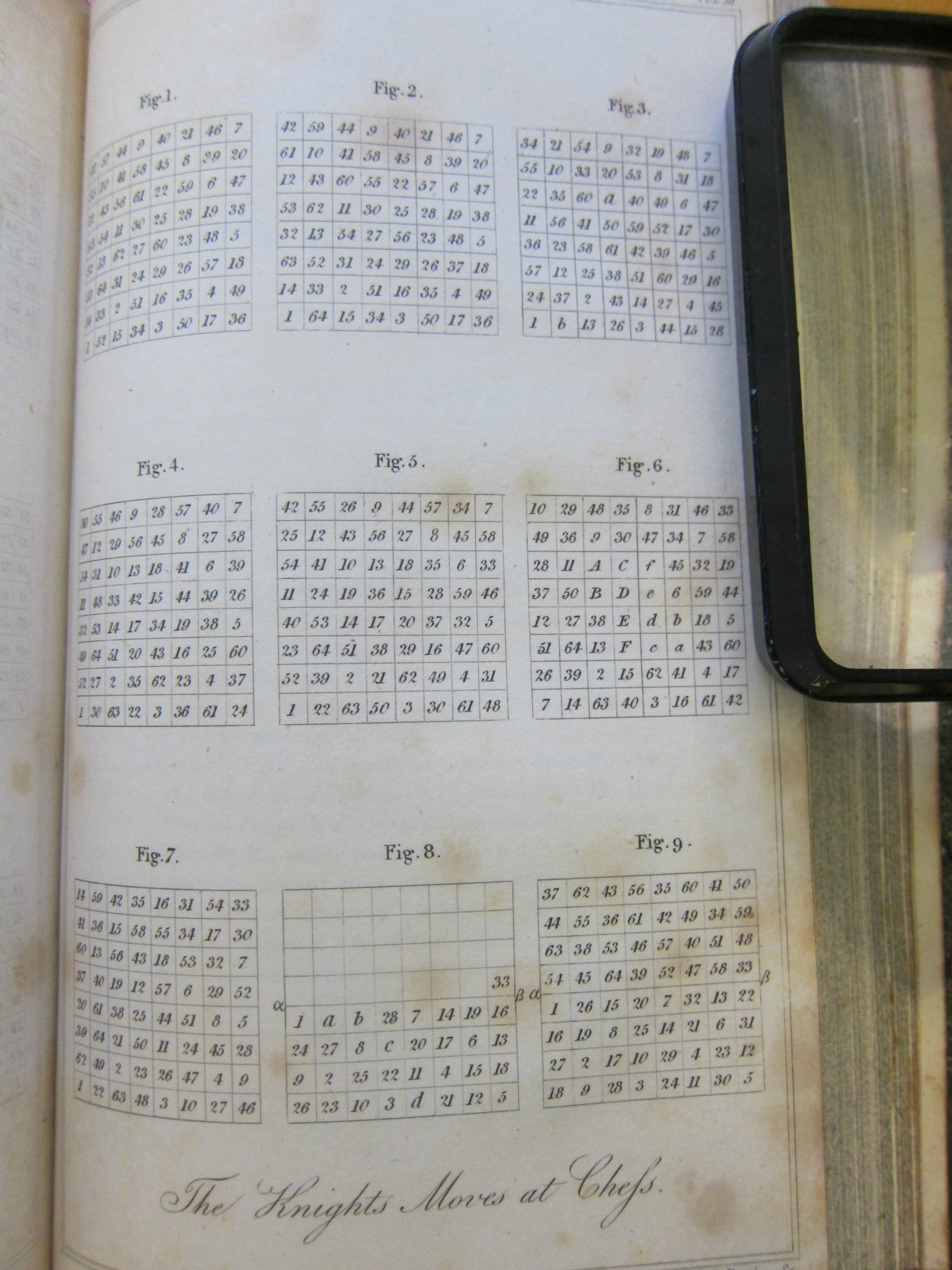
When reading through a volume of the Royal Society’s quarterly publication on the stuff of science (for the year 1817) I came across an article on the Knight’s Tour puzzle: “An Account of Euler’s Method of Solving a Problem, relative to the Move of the Knight at the Game of Chess, from a Correspondent”, published in The Quarterly Journal of Science, Literature, and the Arts, edited at the Royal Institution of Great Britain, published by John Murray for the Royal Institution, London, 1817-1818. After a little digging to find the authorship, I found that the “Correspondent” here is Mr. Charles Babbage himself, with the authorship established at least by the time of his Passages from the Life of a Philosopher if not before. The Knight’s Tour puzzle–in which a knight is moved around a chessboard (8×8 grid, though smaller and much larger have been used) so that every square is touched only once–is ancient, with the host of the famous 18th century mathematical revelers3 positioning the problem in the dim past, with Lucas in 1882 and then Kraitchik in 19272 fixing it more resolutely in India over 2000 years ago.Passages from the life of a philosopher
Babbage identifies the paper as his own in the section of his own “contributions to human knowledge” in his retrospective, Passages in the Life of a Philosopher, published in 1864. I’ve never read this book though I’ve used bits and pieces for research, though last night and today I’ve read in it quite a bit. And apart from the sheer enjoyment of the power of this guy’s mind, I’m finding the book to be unexpectedly amusing. The man is actually funny, plus witty, and an entertaining write–why this is so surprising, I don’t knw; perhaps it is because he is associated in a personal sense in my mind with General Winfield Scott, as they resemble one another, both looking Very Highly Contentious and gassy. In any event, I can safely say that this is a Good Read.
For example, here’s a bit in the appendix, Babbage writing on “miracles”:
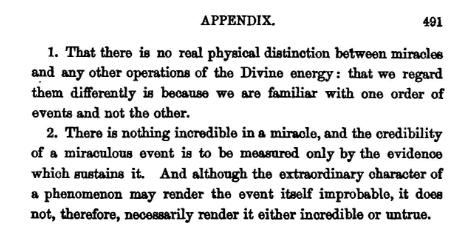
There’s a few pages of reasoning before we get to his enumerated “prepositions”, but this should do nicely. The guy was a very very good thinker.
Full text here: https://archive.org/stream/passagesfromlif01babbgoog#page/n510/mode/2up
Notes