JF Ptak Science Books Quick Post

The odd thing about seeing Vladimir Nabokov in black & white is that he had such an enormous relationship with color, though perhaps the man had the capacity to add color where it wasn’t and then interpret the missing colors as they should or could before passing them on through his synesthesia machine. In any event, I just wanted to post this picture and share–this is an original of some sort (large, at 11×14″) and though I must say I don’t know all that much about him this image seems to be an uncommon one…or at least I don’t recall seeing it before:
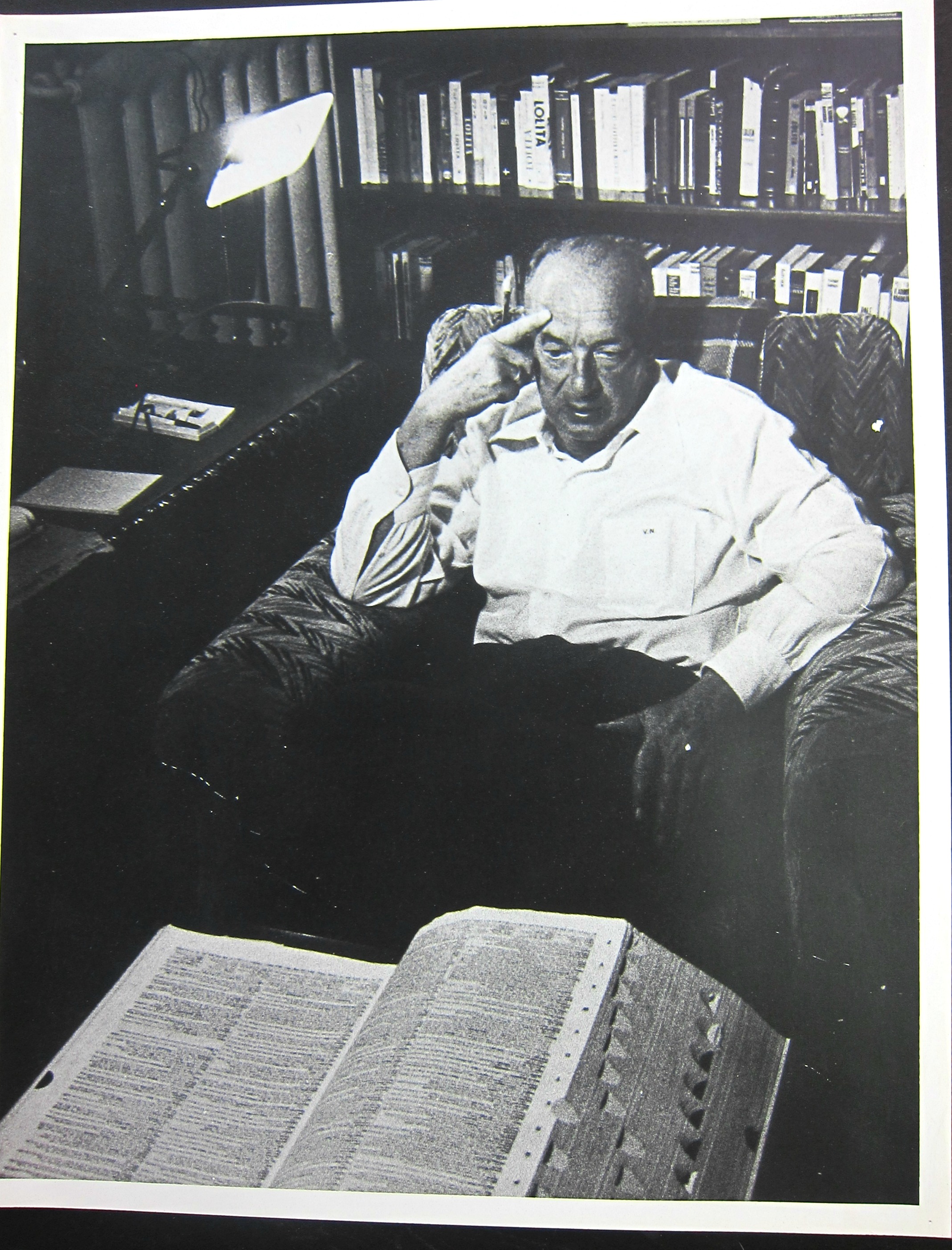
I can’t make out what page the 2nd Webster’s is open to, but it really doesn’t matter. It is interesting to see his collection of Lolita in the background:

In any event, here’s a bit from Speak, Memory, in which Nabokov describes aspects of his synesthesia with color and sound (the quote found originally on the Fury Factory blog, here: https://furyfactory.wordpress.com/2011/06/15/nabokov/):
“…I present a fine case of colored hearing. Perhaps “hearing” is not quite accurate, since the color sensations seem to be produced by the very act of my orally forming a given letter while I imagine its outline. The long a of the English alphabet (and it is this alphabet I have in mind farther on unless otherwise stated) has for me the tint of weathered wood, but the French a evokes polished ebony. This black group also includes hard g (vulcanized rubber) and r (a sooty rag being ripped). Oatmeal n, noodle-limp l, and the ivory-backed hand mirror ofo take care of the whites. I am puzzled by my French on which I see as the brimming tension-surface of alcohol in a small glass. Passing on to the blue group, there is steely x, thundercloud z, and hucklberry k. Since a subtle interaction exists between sound and shape, I see q as browner than k, while s is not the light blue of c, but a curious mixture of azure and mother-of-pearl. Adjacent tints do not merge, and dipthongs do not have special colors unless represented by a single character in some other language (thus the fluffy-gray, three-stemmed Russian letter that stands for sh, a letter as old as the rushes of the Nile, influences its English representation).